Help that
comes to you.
A small robot dog that rolls, climbs a step and carries things for people with limited mobility.
"I couldn't say my own name."
I stutter. For years the phone was a wall. My body worked, and the world was still closed.

The barrier is in the world,
not in the person.
to breed, train and match one dog guide. Many people who could use one never get one, and some can't care for one.
Lions Foundation of Canada Dog Guides · Statistics Canada 2022, July 2025
- Service dogs are scarce.
- Their work is physically hard on them.
- Big dogs can frighten people.
- Not everyone can care for a dog.
- Disability changes from day to day.
- The hard part is arriving with energy left.
Wheels by default.
Legs for steps.
- Rolls most of the time — quiet, efficient
- Steps up curbs and single steps
- Carries & fetches; no feeding, no vet
- You decide what it shares, not your caregivers
Here's how it fails safely.
Reflexes never wait for Wi-Fi
Hardware E-stop. Watchdog parks it after 200–300 ms of silence.
The person owns the account
Camera off by default, physical shutter, no stored video, every access logged.
Toward ISO 13482
The safety standard for personal care robots. No medical claims.
- 01Hardware got cheap. Robot dogs fell from $74,500 (2020) to $1,600 (2023).
- 02AI learned to talk. A robot can hold a real conversation.
- 03Canada is aging. Seniors now outnumber children.
- 04Trained dogs can't keep up. Demand outruns supply.
IEEE Spectrum · New Atlas · Statistics Canada
Built, not just drawn.
- Two-leg rig: 4 joints per leg
- Fuse + current sensor on every joint
- Encoders added to servos that had none
- Wireless controller: joystick, 6 buttons, screen
Scan to join the waitlist
skipstonetechnologies.com/join
Gates, not promises.
- Summer 2026
Found who it's for
- Fall 2026
Two-leg bench rig
- Now · Phase 1
Robot first
- Dec 11, 2026
Seneca HELIX Pitch Day
- Phase 2
Full body
- Phase 3
Pilots with co-designers
Built with the people who live it.
Steven
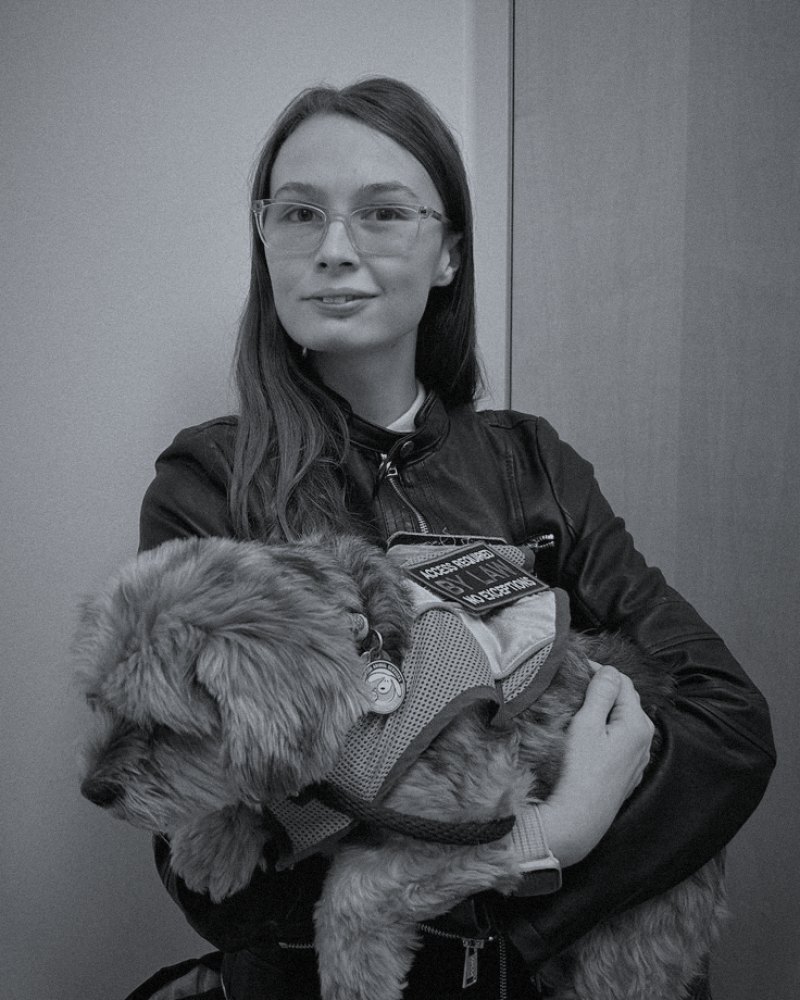
Alison and Zoe

Clare
Help us build
the first real one.
The prize goes straight into our first full prototype. And we'd love 20 minutes with anyone who lives with limited mobility, cares for someone, or trains service dogs.